
So another season passes with Leeds United failing in their attempt to return to the top flight. Having narrowly missed out on the play-off places the previous season, hopes were high that this could be their year, but the Whites went backwards, ending up in the bottom half of the Championship. Poor results resulted in the January dismissal of manager Simon Grayson, who had guided the team out of League One two years ago, to be replaced by the experienced Neil Warnock.
However, there was little improvement, though Warnock’s cause was not helped by the timing of his arrival – one day after the transfer window closed. That said, given the limited investment in the squad in the last few years, it is doubtful whether Warnock would have been able to spend much in any case.
In fairness to Grayson, it must have been difficult for him to make significant progress, as the club has got into the habit of selling its best players. Before a ball was even kicked, goalkeeper Kasper Schmeichel was sold to promotion rivals Leicester City, and then tricky Ivorian winger Max Gradel, Leeds’ player of the year, joined French club Saint-Étienne in August.

"Howson - Jonny, come home"
The fans’ unhappiness was compounded in January when club captain (and local boy made good) Jonny Howson was transferred to Norwich City. Leeds argued that this was good business, as he was in the last year of his contract, but this was not the first time that the club had allowed itself to get into such a situation. In much the same way, other decent players, such as Jermaine Beckford (to Everton) and Bradley Johnson (also to Norwich) had exited stage left.
This lack of ambition is infuriating to most supporters, especially as it is in marked contrast to a ticket pricing strategy that is Premier League in all but name. Even new captain, Robert Snodgrass, was moved to break ranks after Howson’s unpopular transfer, “How can you say you’re aiming for promotion and then sell your captain?”
It’s not so long ago that Leeds United were a force at the very highest levels, reaching the Champions League semi-finals in 2001, before being eliminated by Valencia. This was in the middle of a purple patch when they finished in the top five of the Premier League every season between 1998 and 2002. Leeds were actually the last club to win the old First Division before the creation of the Premier League in 1992.
Going back further, Don Revie’s Leeds side had been even more potent, never finishing out of the top four between 1965 and 1974, winning two league titles in the process in 1969 and 1974, before the FA chose him as England manager. Known far and wide as “dirty Leeds”, this team could also play a bit, as seen when Jimmy Armfield steered the team to the 1975 European Cup Final, where they were defeated by Bayern Munich (in hugely controversial circumstances).

"Peter Ridsdale - riddle me this"
In short, Leeds United were a genuine big club for many years, though they spectacularly imploded after chairman Peter Ridsdale’s catastrophic attempt to “live the dream” resulted in a financial nightmare. Before the likes of Chelsea and Manchester City brought in their billionaire benefactors, Leeds reported the largest ever loss by an English football club of £49.5 million in 2003 (after a £34 million loss the previous year).
Ridsdale’s decision to “go for it” could be described as courageous, though reckless and irresponsible would seem more appropriate. When he jumped ship in 2003, Leeds were around £100 million in debt, after a grand acquisition strategy using innovative finance models, i.e. other people’s money, to fund player purchases. These included high interest sale-and-leaseback arrangements, which allowed Leeds to spread the cost of buying a player over the length of his contract, and a £60 million loan, a record for English football at the time, which was essentially secured on supporters’ loyalty, i.e. future gate receipts.
A consortium of local businessmen, led by insolvency specialist Gerald Krasner, took over Leeds, but the damage was done. When results on the pitch did not improve, the club could not sustain the massive wage bill, leading to a fire sale of players and many other important assets, including the stadium and the Thorp Arch training ground. The financial turmoil ultimately resulted in two relegations with Leeds dropping to the third tier of English football for the first time in 2007.

"Ken Bates - meet the new boss..."
Before that fateful day, Ken Bates had appeared on the scene with the former Chelsea owner looking for “one last challenge.” Even after all the sales, Krasner’s motley crew was still struggling to make ends meet, so a 50% stake was sold to the old bruiser for a reported £10 million in 2005. Or rather to a company called the Forward Sports Fund (FSF).
Despite extensive cost-cutting measures, two years later the club entered administration in May 2007 via a Company Voluntary Arrangement (CVA) with debts of around £35 million, incurring a 10-point deduction from the Football League, which officially relegated Leeds to League One.
The CVA was challenged by HMRC following an initial offer to settle debts at just one penny for every pound owed, but eventually went through (at an undisclosed higher payment) after it was approved by the required majority of 75% of the voting creditors.
Crucially, one of the major creditors, Astor Investment Holdings (an offshore company registered in the British Virgin Islands), said that they were willing to write-off their £17.6 million loan, but only if FSF remained in charge with Bates as chairman. This seemed extraordinarily generous, not only because other bidders offered more money, but it meant that they were supporting a man who had effectively lost them their cash.

"Ross McCormack - just can't get enough"
That does not make much sense – unless Bates was in some way connected to these companies. Indeed, he initially stated that the two shares in FSF were owned by him and his financial advisor, Patrick Murrin, but later corrected this “error” when he revealed that were in fact 10,000 shares in FSF – with undisclosed owners.
Although the club admitted that there had once been a link between Astor and FSF, they said that this had been severed in 2006 before the club went into administration, an explanation that was accepted by the administrators. This may seem a trivial issue, but it is important, as if there had been a link, then Astor would not have been able to vote on the CVA as an “unconnected” creditor and it would not have been passed.
Whatever the circumstances behind the exit from administration, the result was clear: FSF had retained control of an asset, which was now profitable after the slashing of the wage bill, while clearing almost all of the debts. Of course, this phoenix-like rise from the ashes was perfectly legal, albeit perhaps not the most moral course of action, as it left many bills largely unpaid, including many from small businesses and £7.7 million owed to the taxman.
Leeds United did not get away entirely scot-free, as the Football League imposed a further15-point deduction, due to the club not following its rules on clubs entering administration, which meant that they missed out on automatic promotion from League One and ended up losing to Doncaster Rovers in the play-off final.

"Luciano Becchio - don't cry for me, Argentina"
The ownership issue was still far from transparent. Indeed, the report from the House of Common select committee on football governance specifically singled out Leeds for criticism with MP Damien Collins stating, “The principle is that it should never be allowed to happen again that football clubs are bought by offshore trusts of which we have no idea who the owners are.”
Under pressure from the Premier League, who require its clubs to publish the names of all shareholders with stakes of 10% or more, the Football League tightened its rules, following which Leeds “clarified” its ownership: Leeds United Football Club Limited was owned by Leeds City Holdings Limited, which was majority owned by FSF, which was owned by three discretionary trust funds, which were in turn owned by Chateau Fiduciare, a Swiss-based trustee.
Far from clearing up the situation, this statement only added to the confusion, bringing to mind Sir Walter Scott’s famous quote, “Oh, what a tangled web we weave, when first we practice to deceive.”
Never mind, because in May 2011 Leeds issued another statement, following the “scaremongering arising out of the football governance inquiry”, which addressed the ownership issue: “The chairman, Ken Bates, has completed the purchase of FSF Limited for an undisclosed sum. FSF Limited is now owned by Outro Limited, which is wholly owned by Ken Bates.”

"Andy Lonergan - hold it now, hit it"
This was not enough for that man Collins, “Very important questions remain unanswered about the real identity of the previous owners of Leeds United, and the nature of the sale of the club to Ken Bates.” The most obvious question is why FSF would sell at a time when the riches of the Premier League appeared to be within reach, having supported the club through the dog days in League One?
Also, why wouldn’t they hold a beauty contest for other potential bidders to secure the maximum return on their investment? The price that Bates paid was (surprise, surprise) undisclosed, but it is unlikely to be that high, given that the man himself informed the High Court in 2009 that he had little cash with most of his wealth tied up in assets. It is true that there are not too many people rich (or foolish) enough to invest in a football club, but they do exist, e.g. the Liebherr family at Southampton and Vichai Raksriaksorn at Leicester City.
Whatever FSF’s thinking was, Bates is still holding the reins at Leeds. His time as chairman has been colourful to say the least, featuring bans for the BBC and Guardian, when irked by their reports on his activities, and insults aplenty for those fans of the club who have the temerity to disagree with his approach, describing them as “morons” and “dissidents”. That is by no means the end of his seemingly customer hostile strategy, as evidenced by the stratospheric ticket prices.

"Michael Brown - tough love"
Even when he made a valid point about adopting a long-term strategy, it was done in a crass manner, “In an age of instant gratification, Leeds United is having a long, drawn-out affair with plenty of foreplay and slow arousal.”
In fairness to Bates, other owners have gone down the path of splashing the cash with little success to show for it, so his prudent policy is not all bad. As he said, “All football clubs are now realising that you have to get your balance sheet and your profit and losses right first and then play football, otherwise as you're seeing every week you won't be able to play football.”
Indeed, he has managed to steadfastly improve the finances at Leeds, while reversing the club’s slide down the divisions, which is an achievement. However, it should be remembered that this financial recovery was originally due to the tactical administration, which cleared the club’s debts and enabled it to start afresh.
So how do the club’s finances look these days? Not too bad at all.

In 2011 the club made a profit after tax of £3.5 million, which was the highest since the £4.5 million reported in 2008 for the first 14 months after coming out of administration. Even though £2.6 million was due to the club recognising a deferred tax asset arising from previous losses, this still left a solid £0.9 million profit before tax.
Despite a £5.2 million (19%) rise in revenue from £27.4 million to £32.7 million following promotion to the Championship, the profit before tax fell by £1.2 million, as the wage bill grew £2.8 million (20%) and profit on player sales fell by £3.9 million.
Note that these figures relate to the football club (Leeds United Football Club Limited), but there’s not much difference in the holding company (Leeds City Holdings Limited), which reported revenue of £34.5 million and profit before tax of £0.3 million in 2011. In essence, revenue is slightly higher, but profits are lower (by £0.6 million in each of the last two seasons).

In addition to the football club, the holding company owns Yorkshire Radio Limited, Leeds United Media Limited and Leeds United Centenary Pavilion Limited. The latter two companies were only created last year “to allow separate… investment into these particular areas of our business in the future.”
Since coming out of administration, Leeds have been profitable for four consecutive years, a rare feat in the ultra-competitive world of modern football. The combined profits before tax are £7.5 million (2008 £4.6 million, 2009 £0.015 million, 2010 £2.1 million and 2011 £0.9 million), while profits after tax are worth £10.1 million.

In fact, just three out of 24 clubs in the Championship managed to make money in 2011 with Leeds’ £0.9 million only surpassed by Watford £9.6 million and Scunthorpe United £1.5 million. Nine clubs lost more than £10 million, including QPR £25.4 million, Hull City £20.5 million, Middlesbrough £18.7 million and Leicester City £15.2 million.
This is partly a result of low TV money in England’s second tier, but also due to many clubs over-spending in order to reach the promised land of the Premier League. Leeds are very much an exception to this rule. In fact, they are the only club in the Championship to have made profits in both of the last two seasons.

However, the impact of player sales on these results should not be ignored. Excluding the £11.5 million profit made from this activity between 2008 and 2010, the club would have registered losses in each of those three years. As well as normal player sales, the first year after administration benefited from compensation paid by Chelsea for two academy players, Tom Taiwo and Michael Woods. In 2010, the sale of Fabien Delph to Aston Villa transformed a £1.7 million loss into a £2.1 million profit.
The good news is that last season’s profit was entirely due to normal business, as there was no once-off profit on player sales. That was the first year since administration that Leeds made an operating profit (£0.9 million), which represented a £2.6 million turnaround from the previous year’s operating loss of £1.7 million. Next year will be business as usual, as the figures will benefit from the sales of Howson, Gradel and Schmeichel amongst others.

In many ways, it is not that surprising that Leeds are profitable, as their revenue is exceptionally high for a Championship club. At £32.7 million, it is not only the largest in the division, but it is £5-6 million more than the next three clubs in the revenue league (Burnley, Middlesbrough and Hull City), all of whom were boosted by £15 million of parachute payments following relegation from the Premier League.
Excluding that factor, it is clear that Leeds United’s revenue is the highest by some distance with the closest contender being Norwich City, whose £23 million is almost £10 million lower. Incidentally, the other clubs promoted to the top tier in 2011 have even lower turnover: QPR £16.2 million and Swansea City £11.7 million. One conclusion is that Leeds are punching well below their weight.

Revenue has risen over 40% since 2008 from £23.2 million to £32.7 million. Much of that is due to the better TV deals in the Championship compared to League One, but the majority comes from gate receipts and merchandising. Put another way, the club is very reliant on the loyalty of its supporter base for its high turnover.
Last season the fans contributed at least £19 million (gate receipts £12.7 million plus merchandising £6.1 million), which represents around 60% of the club’s total revenue of £33 million. If other activities such as catering were broken out of Other Commercial revenue, the proportion would be even higher.
Of course, the high gate receipts represent something of a double-edged sword, as it its partly due to the very high prices that Chairman Ken charges his fans. Not only are they the highest in the Championship, but, according to a survey conducted by the award-winning Leeds fanzine, The Square Ball, only four clubs in the Premier League have higher priced entry-level season tickets (Arsenal, Chelsea, Liverpool and Tottenham Hotspur).

However, this attempt to squeeze the orange until the pips speak could be counter-productive, as average attendances have fallen by 4,000 (15%) to 23,300 this season, when overall Championship crowds rose 2%. This is still the fourth best in the division, only beaten by one promoted club (Southampton), West Ham and Derby County, but it’s a measure of how much Bates has tested the supporters’ patience.
The previous season Leeds had the highest crowds in the Championship with 27,300 (more than eight Premier League clubs), while they averaged nearly 25,000 in League One. As an indication of the potential at Leeds, average crowds were just under 40,000 at their height in the Premier League.
The decline in attendances this season will cause something like a £2 million hole in the 2011/12 accounts. That will reduce the reported revenue, but the actual cash available to the club is also going to be impacted by an agreement made post balance sheet, whereby the club sold season tickets for both the 2012/13 and 2013/14 season for £5 million in order to finance further development of Elland Road.

Leeds’ total commercial income of £14.5 million is also impressive. To place that into context, it is only just below the money generated from this revenue stream by Aston Villa £16.7 million and Newcastle United £15.8 million, while it is actually higher than many Premier League clubs, including the likes of Everton £11.7 million and Fulham £14.1 million.
However, while merchandising revenue has grown 77% (£2.6 million) in the last three years to £6.1 million, other commercial income has actually fallen 8% (£0.7 million) to £8.4 million in the same period. Leeds recently extended their shirt sponsorship deal with Enterprise Insurance for two years until the end of the 2013/14 season, while the club signed a lengthy six-year kit deal with Macron in 2010. Financial details of both deals were undisclosed.

The influence of television on a football club’s finances is undeniable and Leeds United are no exception. Relegation from the Premier League in 2003/04 led to an immediate £9.4 million decrease with TV revenue falling from £16.9 million to £7.5 million, even though the fall was cushioned by annual parachute payments of £6.6 million for the next two seasons. When these stopped in 2006/07, the club’s finances were dramatically affected with TV money crashing to £1.2 million, which was exacerbated by the relegation into League One giving TV income of just £0.7 million.
The rise in 2010 to £ 1.6 million was partly due to higher payments from the Football League (central distributions £0.64 million, solidarity payments £0.1 million), but also owed a lot to a splendid FA Cup run, featuring four ties against Premier League opposition (Liverpool, Tottenham and Manchester United).
Promotion saw a big increase in TV money, as the Football League distribution to Championship clubs is worth £2.5 million (increased from £1 million in 2010/11) with a £2.2 million solidarity payment from the Premier League (up from £1.3 million). In addition, each club was given an additional £0.5 million as their share of the parachute payments for Newcastle and WBA, because they went straight back up to the top tier.

"Elland Road - I could build you a tower"
Although there is never a good time for a football club to be relegated, it is fair to say that Leeds’ timing was particularly unfortunate, as they missed out on the significant growth in TV deals, e.g. the three teams relegated from the Premier League last season received an average of £40 million compared to Leeds’ £17 million in 2004. Similarly, while their relegation was eased by £13 million of parachute payments, teams now will receive £48 million (£16 million in each of the first two years, and £8 million in years three and four).
The other cloud on the horizon is the new Football League Sky TV three-year deal that kicks off in the 2012/13 season, which will be £69 million lower than the current contract at £195 million, a reduction of 26% or £23 million a season. This reflected what Football League chairman Greg Clarke called, “a challenging climate in which to negotiate television rights.” Whatever the reason, it will mean a reduction in the payments distributed to Leeds.
This is another reason why it is a little puzzling that Leeds do not push harder for promotion to the significantly more lucrative top tier, as that would conservatively be worth around £90 million. That doesn’t come in one fell swoop, but it’s still a magnificent prize. Even if a promoted team comes straight back down, it would receive £40 million TV income plus £48 million parachute payments over the next four years. Leeds would also benefit from much higher gate receipts and better commercial deals.

Furthermore, if Leeds were to finish higher in the Premier League, they would receive even more TV money with every season survived adding another £40+ million to the coffers. This explains why many clubs push themselves to the absolute limit to secure promotion, though it’s a dangerous game, as only three clubs go up every year.
One concern is that a promoted club might eat into that higher revenue by increasing wages and other costs, but the net effect is still likely to be positive. If we look at the three teams that were promoted to the Premier League in 2009/10, we can see that Newcastle United, WBA and Blackpool all dramatically improved their operating profitability, even though wages increased.

Leeds’ wage bill has long been a bone of contention among the fans, as it is very low compared to the club’s turnover. Despite a 20% (£2.8 million) increase from £13.7 million to £16.5 million in 2010/11, the wages to turnover ratio is only 51%, which is not only the lowest in the Championship, but is also lower than all but two clubs in the Premier League (Blackpool 48% and Manchester United 46% - though United benefit from enormous revenue of £331 million). Since exiting administration in 2007, wages have grown by just £3.8 million, while revenue has increased by £9.4 million.
This is the football club’s total wage bill, comprising £14.9 million salaries and £1.6 million social security. It is higher in the holding company, but only by £0.5 million, at £17.0 million. Directors’ emoluments are also up, rising from £174k to £299k, presumably largely for Shaun Harvey, the chief executive, as Bates “did not receive any benefits.”
According to the club website, “First team squad and management costs were £11.6 million, increasing from £7.7 million in the previous period.” They do not explain why the increase in these costs is higher than the overall growth in the wage bill, but it is probably due to bonus payments (including additional payments for loan players) made in 2009/10 for promotion. After Grayson was fired, Bates claimed that he had allowed his manager to go over his wage budget of £9.5 million in 2011/12 by 23% at £11.7 million, but that will only be confirmed by next year’s accounts.

While Bates has defended his record here (“At 30 players we have one of the largest squads in the Championship”), the figures do not lie and clearly show that Leeds’ wage bill is strictly mid-table in the Championship, coming in at the 12th highest in 2010/11. Leeds’ £16.5 million was around half the £30 million that QPR paid, though part of that will include promotion bonuses.
Although many Championship clubs have over-stretched themselves with nearly half reporting unsustainable wages to turnover ratios over 100%, they do not enjoy Leeds’ revenue advantages. All other things being equal, the Whites could safely increase their spending on player wages without going crazy.
If they targeted the 60% ratio adopted by Football League clubs in Leagues One and Two, that would mean an increase of £3.1 million to £19.6 million; if they opted for UEFA’s recommended upper limit of 70%, that would mean an increase of £6.4 million to £22.9 million. Either of those options would provide a budget good enough to mount a meaningful promotion challenge, more than the two other clubs that went up in 2010/11: Norwich City £18.4 million and Swansea City £17.4 million.

However, another factor needs to be considered at Leeds, namely the high amounts spent on Other Costs. Excluding salaries and amortisation, these stand at £13 million, which is very high for a club outside the Premier League. If we compare that with other Championship clubs with high revenue (not benefiting from parachute payments), we can see that Leeds have the highest Other Costs, e.g. twice as much as Norwich and Reading, with the highest proportion of total costs, though, in fairness, it does not look too high as a proportion of revenue,
Unfortunately, the club does not provide much detail for these costs, but one of the significant items is the rent paid for the stadium and training ground, after their sale and leaseback, which is around £2 million (increasing by 3% every year), a major financial burden. Nothing was identified for legal fees in 2011, but these have also been on the high sides in recent years: between 2008 and 2010 a total of £1.5 million was paid to a company controlled by RM Taylor, a director of the holding company.

Where Leeds have not spent big is in the transfer market, at least since the Ridsdale era. His unwise spending culminated in £69 million in the two years up to 2002, followed by a massive fire sale that produced £101 million of net proceeds in the next three years. Since then, the club has continued to make money from player trading with net proceeds of £15 million: £4 million in the four years up to 2009 and £11 million in the last three years.
Although Simon Grayson spent very little, having to mainly make do with free transfers and loans (an incredible 33 in his 37 months reign), he put a brave face on this, “Money isn’t the answer. It’s a help. It’s good management and scouting.”

It is undoubtedly true that money is no guarantee of success, as can be seen over the last three years with the likes of Leicester City and Nottingham Forest under-performing despite being among the highest spenders. Nevertheless, only four clubs have spent less than Leeds in this period – though admittedly one of those is Reading, who have just secured promotion to the Premier League.
It will be interesting to see if Bates continues his tight hold on the purse strings after the arrival of Warnock, who argued, “We’ll have to invest. The chairman knows what I’m looking at and what I think. The job requires major surgery in all departments.”

Net debt (in the holding company) is just £0.5 million, comprising a loan from Outro Limited (Bates’ company) of £975k, which has since been repaid, £149k of finance leases less £600k of cash. This is very respectable, though not as good as the previous year when the club held nearly £4 million of cash. Of course, the low debt levels are perhaps not that surprising after writing-off so much as a result of the administration.
However they got there, this is a better position than the vast majority of other clubs, as can be seen by the concerns of the Football League chairman, Greg Clarke, “Debt's the biggest problem. If I had to list the 10 things about football that keep me awake at night, it would be debt one to 10. The level of debt is absolutely unsustainable. We are heading for the precipice and we will get there quicker than people think.”
That said, Leeds do have other important potential liabilities: (a) if they are promoted to the Premier League before the 2017/18 season, they have to pay £4.75 million to the liquidator; (b) £875k may be payable on transfer fees depending on player appearances and/or Premier League promotion. Note: Leeds owe £133k transfer fees, but have transfer debtors of £988k.

"Adam Clayton - losing his edge?"
In addition, a total of £3.2 million has been raised via preference shares, which is a hybrid form of financing somewhere between equity and debt. These are worth £4 million when redeemed, guaranteeing a profit of £0.8 million for persons unknown. There is no fixed date for repayment, but they may be redeemed if the club is sold, liquidated or the majority shareholder (that would be Bates via Outro) decides to buy the shares.
Finally, there are the future receipts owed via the pledging of season ticket money (portion unspecified) to part fund the development of the Elland Road East Stand.
The football club’s balance sheet looks fairly strong with net assets of £10.6 million (up from £7.1 million), especially considering that the value of players in the books is only £1.5 million, compared to a real world valuation of £12.2 million (“based on the average opinions of seven members of senior football management”). Working capital is negative, but has been improving (from £5.7 million in 2009 to £1.2 million in 2011) and includes £8.1 million of prepayments of tickets and sponsorship revenue.
It also includes £4.6 million owed to other group companies (up from £0.4 million the previous year), which means that money from the football club is flowing to other companies, as opposed to being invested in the squad. The holding company notes that £2.1 million has gone to Yorkshire Radio.

The cash flow statement shows that Leeds generates money at an operating level (£9.1 million since administration), which is boosted by £5.4 million cash from player sales, but £16.6 million has been spent on capital projects, such as new executive boxes and lounges. This is consistent with Bates’ claim that “approximately £20 million” has been spent on “the clapped out, decaying stadium that I inherited”, but it gives the lie to his assertion that “all the money we have received has gone back into the squad.”
Clearly, improving stadium facilities is no bad thing, but it may be a case of putting the cart before the horse, if the club is prioritising property development before promotion. Bates has recently stated in his programme notes that the rebuilding, refurbishment and improvements of Elland Road are nearing completion, which would theoretically increase the money available to bolster the team, though, as we have seen, millions are still being invested into the East Stand.
This focus on property development should come as no surprise, as Bates once said, “In my view a football club is a property business that hosts a football match 25 days a year and is shut for the other 340 days.” While it does make sense “to increase the income generating potential of the club on non-match days”, this strategy has not always proved successful, as Bates himself should appreciate after Chelsea Village was on the brink of financial collapse before Roman Abramovich flew to the rescue.

"Tom Lees - searching for the young soul rebels"
Leaving aside reservations over whether the proposed hotel, superstore, retail arcade and casino are mere vanity projects that will not generate much revenue, the burning question is why the club should invest millions in properties that it does not own?
Stop me if you’ve heard this one before, but it is not clear who owns the stadium beyond Teak Commercial Limited, an offshore company registered in the British Virgin Islands in January 2005 (coincidentally the same month that Bates became Leeds United chairman). The uncertainty about ownership has already contributed to the local council rejecting an application from Leeds for a development loan, though this decision was also partly due to the failure of England’s 2018 World Cup bid.
Either way, what might be of interest to a potential investor is that the club has the opportunity to purchase Elland Road for £14.85 million, which was valued at £54.72 million according to the accounts, while Bates has confirmed that they could also buy back the training ground for £5 million.
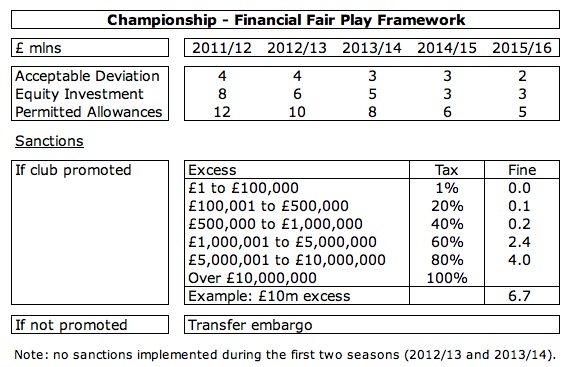
Furthermore, Leeds should be a beneficiary of the new Financial Fair Play (FFP) framework, which was approved by the Championship clubs in February. This will see the introduction of a breakeven model, requiring clubs to stay within pre-defined limits on losses (falling from £4 million in 2011/12 to £2 million in 2015/16) and shareholder equity investment (falling from £8 million in 2011/12 to £3 million in 2015/16).
If clubs are promoted to the Premier League with losses above these limits, any excess will be taxed with any proceeds distributed among the clubs that comply with the FFP regulations, while offending clubs that fail to achieve promotion will be punished with a transfer embargo. However, no sanctions will be implemented during the first two seasons in order to give clubs a sensible period of transition, so it will be a while before this helps Leeds.
On the other hand, Leeds voted against the introduction of the Elite Player Performance Plan (EPPP), as this is likely to hurt their ability to sell young stars to top clubs for large sums. This has resulted in the club “reviewing our Academy structure to ensure we are best placed to benefit from its provisions.”

"Warnock points the way forward"
In conclusion, Leeds United are the proverbial sleeping giant, a club with a fine history and bags of potential, but it can only be realised with promotion to the Premier League. Love him or loathe him, Neil Warnock has a proven track record in getting teams promoted, but he will need financial backing to do the same with Leeds.
To date, Ken Bates has not provided his managers with an adequate budget, his attitude encapsulated by his comment after dismissing Simon Grayson, “We are building a club first and a team second and we are making progress when so many people are having financial difficulties.” Fair enough, but it could also be a false economy to not spend more and miss out on the riches available in the top flight.
More encouragingly, Bates suggested that this might be about to change, “We want to be in the Premier League and we will support Neil in the quest to get us there.” Leeds fans might be forgiven for taking this with a pinch of salt, but there is little doubt that the club could afford to be more aggressive with its spending on the pitch – without entering dangerous territory. Or will it be another chapter of broken dreams?


